

For hedge fund managers navigating an increasingly competitive fundraising landscape, the question of where to allocate investor relations resources is not merely tactical. It is existential. Pension funds, endowments, and sovereign wealth funds receive relentless attention, their gatekeepers overwhelmed by pitches and their allocation committees bound by rigid mandates.
Hedge funds have responded by being more flexible and open to different investment structures. For example, a recent industry survey indicates that approximately 47–63% of hedge fund managers currently accept or would consider allocations via Separately Managed Accounts.
Meanwhile, a capital source that is rapidly growing in size, sophistication, and flexibility has been underserved by many managers: the family office.
There are increasingly compelling reasons for hedge funds to focus on family offices, including the structural advantages of their portfolios, their tolerance for volatility, their preference for specialized strategies, and their openness to emerging managers.
Fewer Competing Allocation Targets
The first and perhaps most structurally significant advantage of pursuing family offices is that their portfolios contain far fewer allocation mandates than those of large institutional investors.
A public pension fund must satisfy trustees, actuaries, regulators, and beneficiaries simultaneously, resulting in an often-rigid asset-allocation framework. Hedge funds compete with hundreds of peers for a narrow slice of predetermined allocations in alternative assets. Family offices face no such constraint.
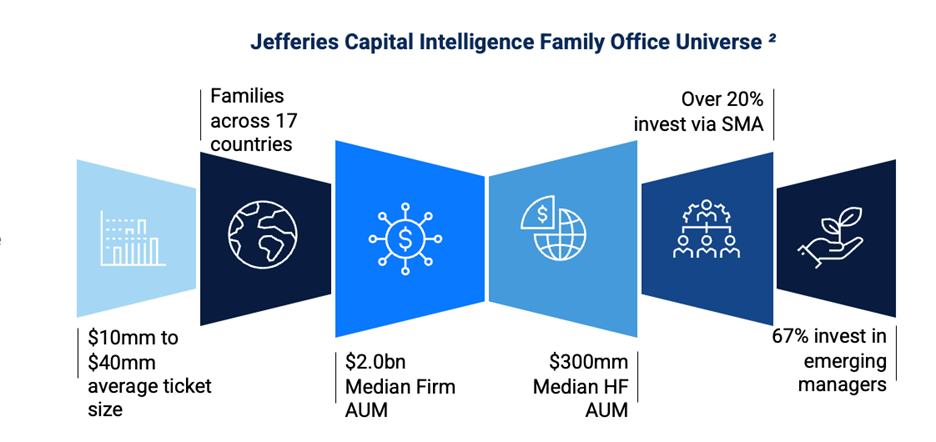
Investment teams in family offices are typically lean, often consisting of fewer than five people, and they can be more agile in allocating capital to areas of the market where others cannot.
Many family offices make key decisions through fast, consensus-based collaboration between staff and family members, while many others rely solely on family members. This approach eliminates institutional red tape.
With fewer constraints and comparatively high return targets, family offices often stand apart from institutional counterparts such as insurers and pension funds. Hedge funds that cultivate a family-office relationship often compete for a comparatively large and more flexible share of an investment portfolio.
Long Time Horizons and Tolerance for Volatility
Family offices are structurally predisposed to tolerate volatility in ways institutional investors are not. Pension funds face mark-to-market pressures, quarterly reporting cycles, and beneficiary expectations, all of which create short-term sensitivities. Family offices that manage multi-generational wealth operate with “patient capital,” and without pressure from outside investors.
This long-termism has direct practical implications. Common hedge fund strategies that concentrate positions, accept lock-up periods, or engage in event-driven and distressed investing — which can lead to short-term drawdowns but superior long-term returns — are far better suited to a family office investor than to a pension fund whose trustees may get antsy after a subpar stretch of performance.
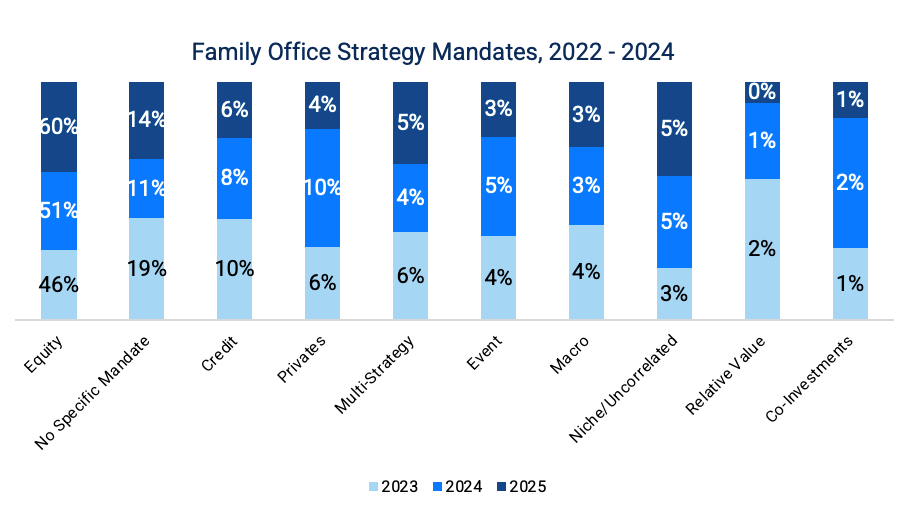
For managers running higher-volatility strategies, that absence of pressure is enormously valuable in sustaining a stable investor base.
A Preference for Sector Specialization
The investment preferences of family offices closely align with the expertise of specialist hedge funds. Family offices frequently seek investment managers with sector-specific interests, including Energy, Financials, Industrials, Healthcare, and Technology, Media, and Telecommunications. This reflects the origins of family wealth: many family offices were founded by entrepreneurs who retain deep industry knowledge and seek managers who can match that expertise. In 2025, about 65% of family office allocations to equity managers were to sector specialists.
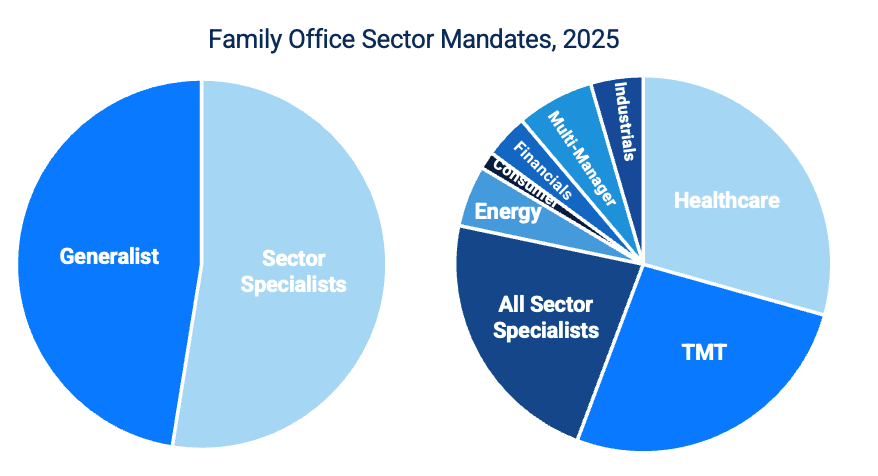
In the years ahead, healthcare and real assets stand out as sectors poised to benefit from demographic shifts and long-duration investment horizons. For a hedge fund with genuine expertise in specific sectors, family offices represent a more natural investor base than broad institutional platforms, which often favor diversified allocators over focused specialists.
Openness to New and Emerging Managers
Finally, family offices often demonstrate more willingness to back emerging managers. Public pension funds are subject to governance constraints and reputational risks, making them reluctant to back funds without established track records.
The result is that institutional capital consolidates in the largest, most established funds, leaving new entrants without access.
Many of the entrepreneurs behind family offices also intuitively understand the journey of an emerging enterprise. Early in their careers, they asked investors to bet on their judgment and differentiated insights rather than on institutional infrastructure. That often makes them more likely to make a similar bet on an emerging hedge fund manager. Last year, as much as a third of all family office allocations went to emerging managers.
It is a case of supply and demand: Family offices have a demand, and Jefferies has the resources to meet it.
The Jefferies Capital Intelligence team is attuned to these trends because we have a robust, diverse client base that includes many emerging and sector-focused managers, as well as 400+ family office relationships, creating opportunities for meaningful introductions.
According to some projections, by 2030, there will be more than 10,000 family offices globally managing over $5.4 trillion in assets, a figure that would surpass the hedge fund industry’s total AUM. That represents an enormous capital base, managed by investors who are agile and actively seeking managers who match their sophistication.
For hedge fund managers willing to invest their time and attention in expanding their work with family offices, the opportunity is substantial.