
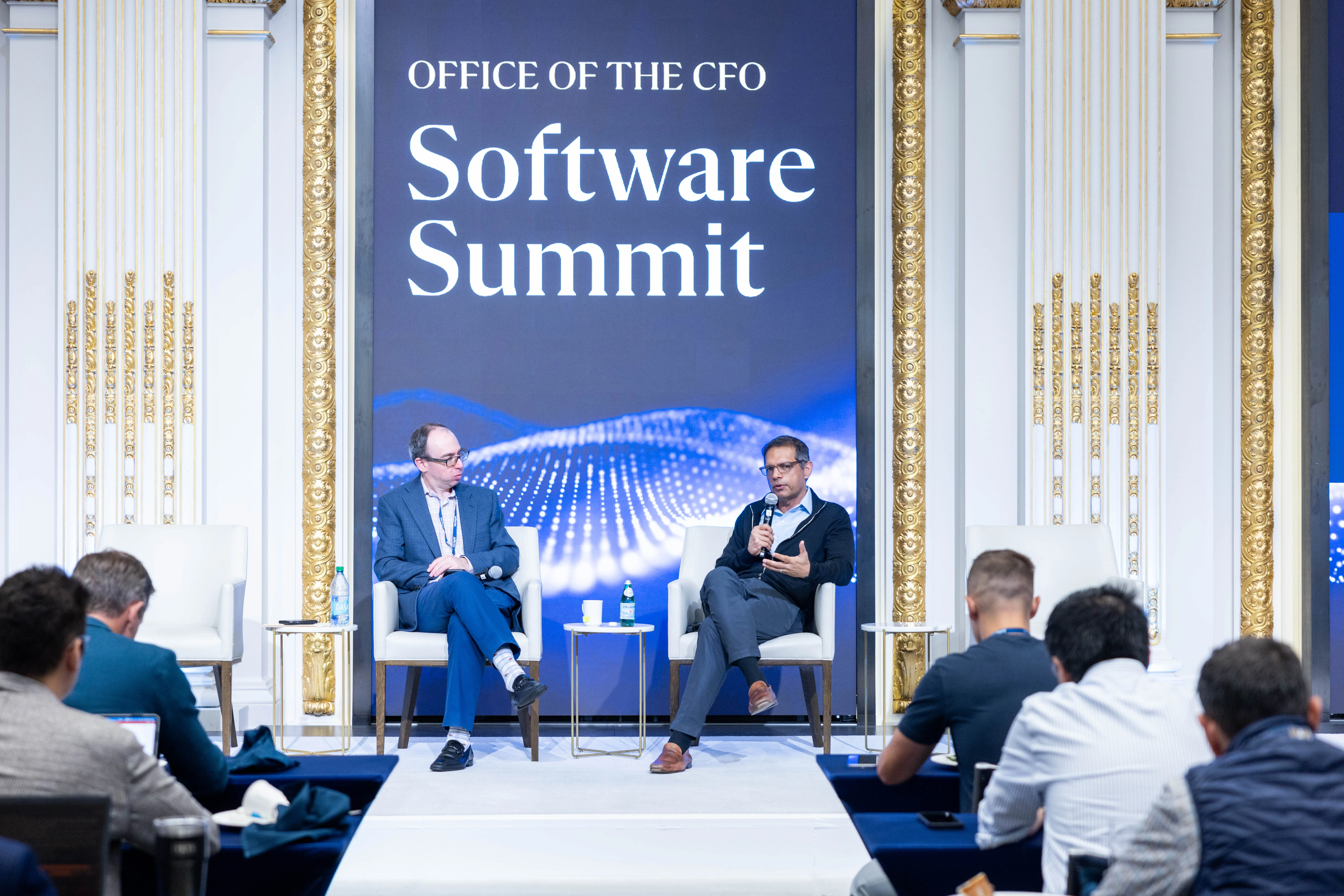
On August 12, Jefferies hosted its fourth annual Office of the CFO (OCFO) Summit at the New York Stock Exchange, bringing together business leaders across finance, technology and consulting.
The summit explores the CFO’s evolution from its traditional finance mandate to its role today: the strategic hub of the modern enterprise. This evolution has fueled a growing market for software supporting the OCFO’s functions, and more investors and entrepreneurs enter the category each year.
This year’s gathering focused on a fundamental tension facing financial leaders: as agentic tools reach the OCFO, how do you bring increasingly autonomous AI into functions built around sensitive data, tightly controlled systems and zero tolerance for error? And what needs to change—in technology, processes and governance—for companies to capture agentic AI’s potential without compromising trust?
Akash Bhatia, Senior Partner at Boston Consulting Group and leader of its technology sector, joined Jefferies Managing Director Evan Osheroff to discuss.
The Gap Between AI Adoption and AI Transformation
AI is one of the most important strategic considerations for boards and management teams across BCG’s global client base. Yet enterprise adoption remains fairly shallow in Akash’s experience, and he views the transition to fully agentic workflows as still far off.
The gap, he explained, is between individual and functional productivity. Employees are using AI to search, summarize and complete discrete tasks, but those gains have yet to translate into dramatically more productive departments.
“In some ways, it’s a failure of imagination. People are looking at functions like FP&A and taking a very incremental view. They’re asking, ‘How do I get 10 percent more productive? 20 percent more productive?’ This is the reality of big enterprises,” Akash explained. “We’re in the ChatGPT, Claude Code era. The fully agentic era is far away.”
Akash advised companies to set their sights on the larger opportunity. Rather than layering AI onto existing processes, they should start with a blank sheet of paper and ask: If this technology had existed from the beginning, how would we design the workflow today? That level of reinvention can be difficult for large enterprises, but it is necessary to fully realize the potential of agentic AI.
Part of that process, Akash said, is avoiding the age-old enterprise mistake of handing projects to IT teams and awaiting implementation. Instead, leaders may need to take the uncomfortable step of embedding AI engineers directly within functions like finance and sales, where they can drive ambitious change from within – sort of like an inhouse “FDE” model.
The New Economics of AI-Native Companies
The conversation then turned to AI’s potential to blur the lines between traditional categories of companies. Historically, Akash explained, software companies, systems integrators and strategy consultants occupied distinct roles. Increasingly, AI is allowing companies to combine elements of all three.
He pointed to the forward-deployed engineer model. Software companies are providing more hands-on implementation, consulting firms are building software, and AI-native services companies are increasingly selling outcomes rather than tools.
That convergence raises a fundamental question about the economics of these emerging businesses. “Everyone knew what the P&L of a traditional SaaS company looked like,” Akash said, down to metrics like COGS and R&D spend. “What does the P&L for the AI-native company of the future look like? No one knows!”
Should Enterprises Rent or Own Their Intelligence?
Finally, Akash addressed another choice facing enterprises in their AI journeys: frontier versus open-weight models, and the tradeoffs in capabilities, cost and control.
A growing range of open-weight models, including Beijing-based Kimi, offer increasingly capable alternatives to the soaring inference costs of OpenAI and Anthropic. For enterprises—particularly those handling sensitive financial data—that creates new choices around where their intelligence lives and who controls it.
Akash framed the decision simply: “Do you want to rent your intelligence or own your intelligence?” A growing number of companies are helping enterprises build their own AI systems using open-weight models, train them on proprietary data and retain greater control over how they are deployed.
“This is going to place significant pressure on an OpenAI or Anthropic to react,” Akash said.
The Path to the Agentic Enterprise
Akash’s insights highlight the distance between today’s enterprise AI adoption and the more ambitious agentic future. For leaders across the OCFO, the opportunity requires rethinking how financial workflows are designed and how to balance greater technological autonomy with the control and trust these functions demand.
These questions were explored throughout Jefferies’ OCFO Summit, which featured more than a dozen sessions with leaders across finance, technology and investing. For more insights from the conference, follow Jefferies on LinkedIn.