
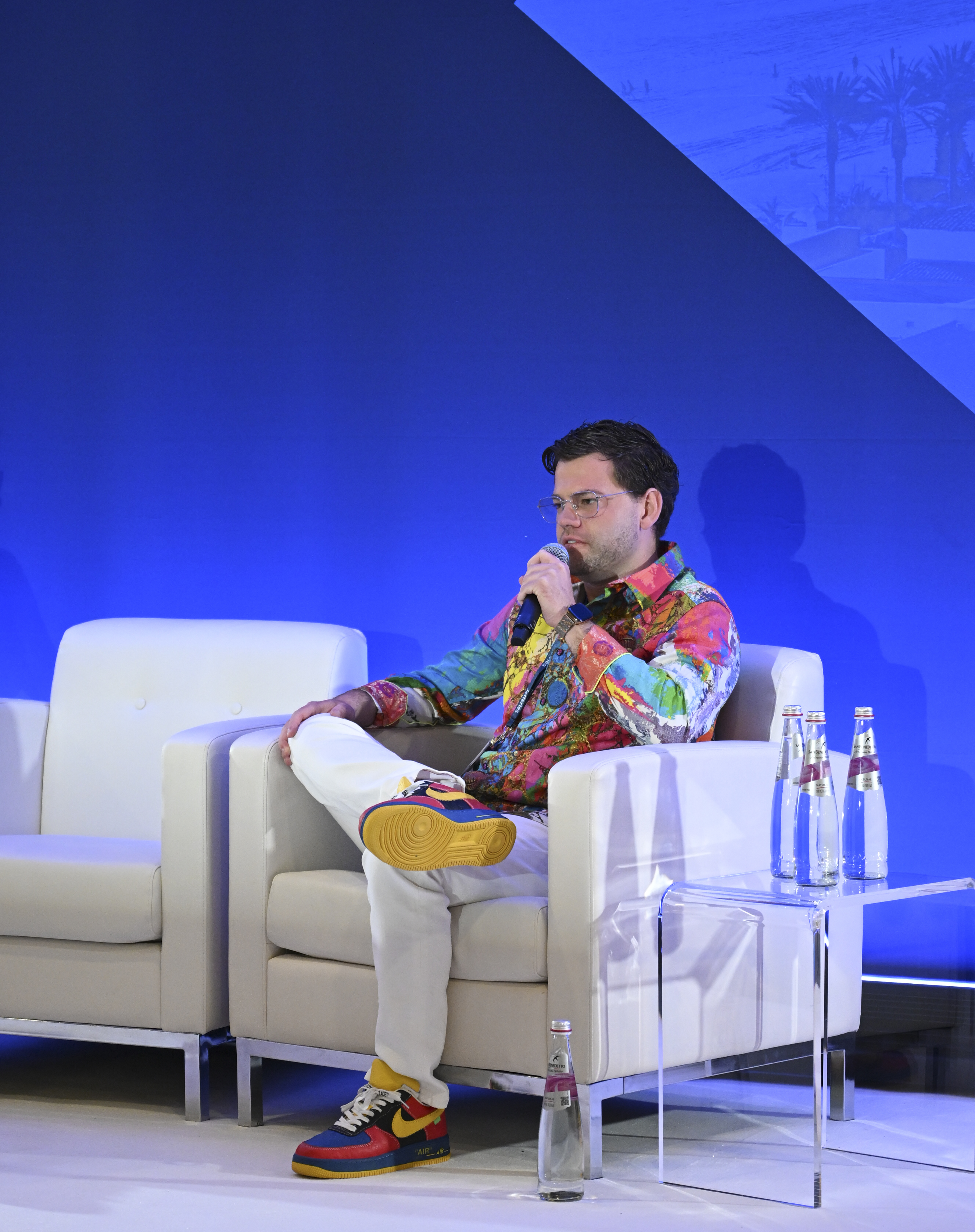
Zeb Evans has been an entrepreneur since childhood, but it was a series of near-death experiences that sharpened his obsession with time, productivity, and efficiency. That obsession led him to found ClickUp, the first Converged AI Workspace. It replaces 20+ siloed tools with one AI-native platform where every workflow runs on full business context. Today ClickUp is one of the fastest-growing enterprise software platforms in the world, with millions of users across industries well beyond the tech sector, and a homepage that makes a deliberately bold claim: software to replace all software.
Evans sat down at the Jefferies Private Growth Conference in Santa Monica, where he described the event as “speed dating at its most efficient — exactly who we are as a productivity company,” to talk about context, consolidation, and what it takes to build a company that outlasts its founder.
ClickUp calls itself software to replace all software. That’s a provocative claim in the current environment!
It sounds provocative, but I think the premise of the alternative is actually ridiculous. If building your own software was the answer, why hasn’t everyone done so? It’s ridiculous to think that normal people (namely 80, 90% of the world) would ever do that. Even the companies that are going down the path of building their own tools are still using software to build other software. Our thesis is simply that it’s better to have all of your software in the same place, with the same users and the same data model. The efficiency you gain from that consolidation is the same efficiency that AI demands. AI wants all of your context. It wants all of the human feedback. So I don’t see our vision and the AI wave as divergent at all.
You keep coming back to context. Why is that the word that matters?
Because it’s the only thing that matters in AI. Routing between models is easy. We stitch together hundreds of different LLMs in real time and route to the best one for a given task or the cheapest one if a customer wants to optimize for cost. That part is solved. The hard problem is stitching together the context with the model. You’re limited by tokens, so every single word you give AI matters enormously. The leapfrog moment that people remember from their first time using ChatGPT is available in enterprise software, but only if the context is right. Without it, you’re just using a generic model that produces average outputs evaluated against average standards. What makes AI genuinely powerful for a business is company-specific context: what your team considers good work, what your standards are, how you evaluate outcomes. Every company, every team, every person has different standards. We’re still in a world of generalised AI where everything is evaluated the same way. Context is what changes that.
How do you get into a company that’s deeply embedded with Salesforce, ServiceNow, or other incumbents?
There are two types of customer. The first actively wants consolidation, often driven by AI. They want all their context in one place, all their people working in one system. For that customer we’re often the only option that can genuinely deliver that. The second type is harder… they’re not ready to rip out everything at once, and you don’t ask them to. You win in one thing first. Get into one workflow, prove the value, and then expand from there. What we’ve seen consistently is that once someone comes to us for one solution, they start using our chat functionality almost automatically because it’s so seamless. The moat we’re building is human engagement: where are people actually spending their time in the day? If we own that, we can start doing things for them automatically, and the case for replacing additional tools becomes obvious over time.
ClickUp 4.0 was a complete overhaul of the user experience while millions of people were using it. How did you approach that?
The back-end platform, the databases, the infrastructure, all of that has been consistent since the beginning. What changed with 4.0 was the experience. The core insight was that you can’t replace all software by packing everything into one bloated interface. So we built what we call personalised software: the platform moulds itself to who the user is within the workspace. A salesperson sees CRM. A support person sees the help desk. A knowledge manager sees docs and knowledge bases. It’s dynamic based on who you are. We effectively woke up millions of users one morning to a completely different application, which I don’t think any company has ever really attempted. Every engagement metric went up after 4.0. We didn’t lose customers. And 5.0 is already in my head — we’re going to do it again.
80% of your customers are outside the tech industry. What does that tell you about where AI adoption actually is?
For most of those customers, their AI strategy until recently was ChatGPT. That was it. And they’re not wrong to have started there, but it’s also why the outcomes have been hard to measure. Outside of engineering, most companies are still trying to figure out where the actual customer value from AI is showing up. It feels more productive, it seems more efficient, but where exactly? Our job has been to show them where the productivity is coming from, identify the bottlenecks, and measure the outcomes in a way they can actually point to. If you can’t measure the outcome, you can’t scale the strategy. And ironically, even the most advanced enterprises that try to build everything themselves end up with the same problem we set out to solve: dozens of different tools, siloed data, and context lost everywhere.
What does long-term success look like for ClickUp?
I’ve always been building toward a public company. I think those are the ones that survive long enough to become genuinely legendary, the ones that are still here when I’m gone. But more than the listing, what I think about is how to keep the company’s ethos intact over ten, twenty, thirty years. The willingness to take risks, to blow things up and rebuild them, to change radically when it’s needed. That’s hard to sustain as a company scales. You look at Apple: they built the first AI assistant, and now they’re paying OpenAI and Gemini to power what should be their own product. They’ve stopped launching things that are genuinely new. I think about that a lot. How do you keep the founder mentality alive in a company that doesn’t have the founder running it anymore? I don’t have all the answers, but it’s the question that matters most to me right now.