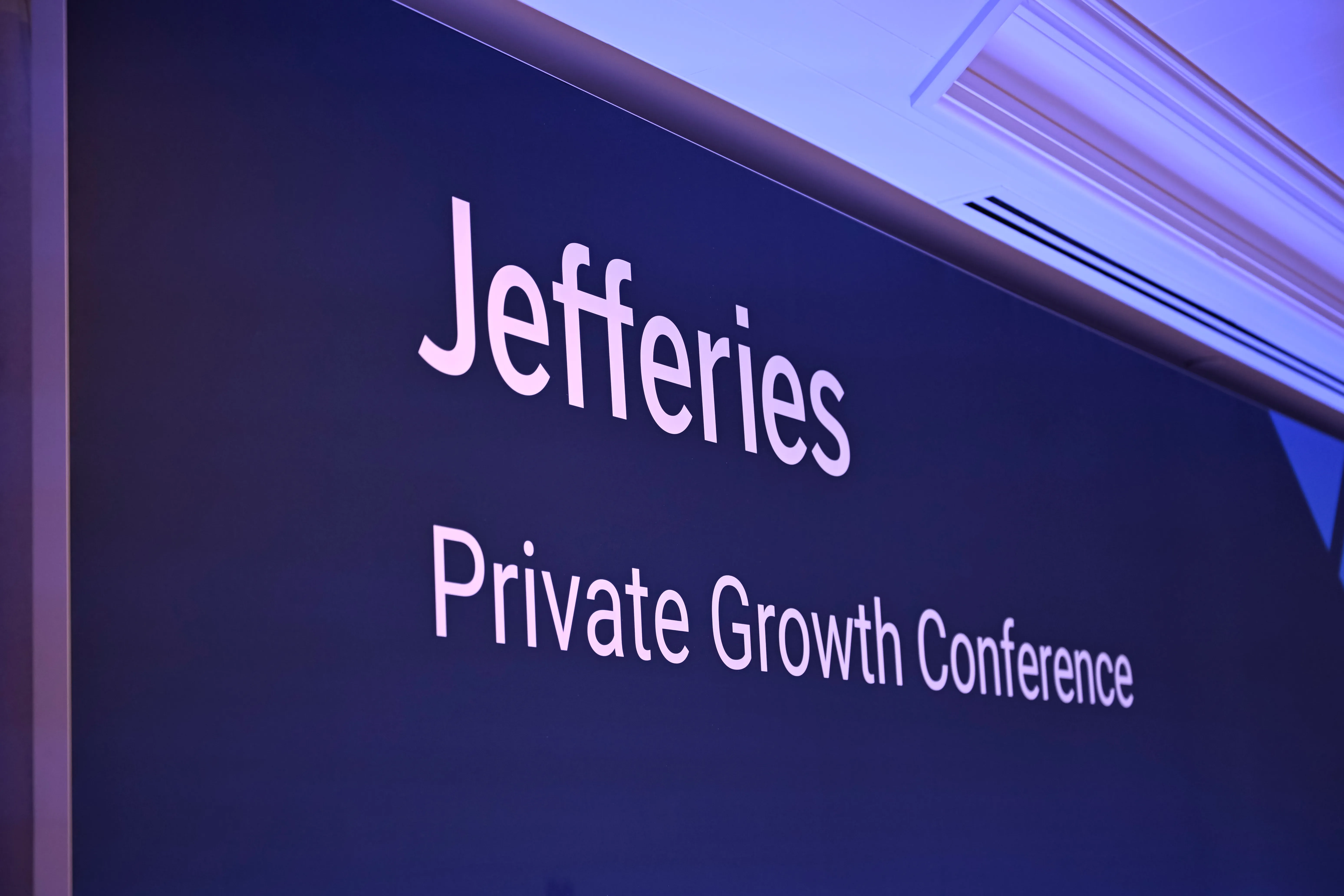
Perspectives from Becky Steinthal, Head of TMT Equity Capital Markets; Stefani Silverstein, Americas Head of TMT; Raphael Bejarano, Global Head of Investment Banking and Capital Markets; Cameron Lester, Vice Chairman of TMT Investment Banking; Brett Rochkind, Managing Partner at SoftBank; and Anish Acharya, General Partner at Andreessen Horowitz — all speaking at the Jefferies Private Growth Conference, Santa Monica, April 2026.
The Mood at the Starting Line
2026 IPO Market Outlook: Insights from Jefferies Private Growth Conference
Perspectives from Becky Steinthal, Head of TMT Equity Capital Markets; Stefani Silverstein, Head of Americas TMT; Raphael Bejarano, Global Head of Investment Banking and Capital Markets; Cameron Lester, Global Co-Head of TMT Investment Banking; Brett Rochkind, Managing Partner Americas at SoftBank; and Anish Acharya, General Partner at Andreessen Horowitz — all speaking at the Jefferies Private Growth Conference, Santa Monica, April 2026.
+++
The Mood at the Starting Line
After years of false starts, the IPO market feels like it is approaching a genuine inflection point. The consensus among bankers and investors at this year’s conference was notably more optimistic than the macro backdrop might suggest. That optimism has since found its first proof point: shares in chipmaker Cerebras Systems more than doubled on its market debut after raising $5.5 billion, the largest IPO of the year, confirming that investor appetite for the right AI story is very much alive.
“It feels like we are at a pretty definitive pivot point in the market,” said Becky Steinthal, Head of TMT Equity Capital Markets at Jefferies. From 2023 through mid-2025, she described the market as a supply drought: investors were open for business but companies refused to come to market. That then flipped into a demand strike, with investors growing picky and selective after being burned by underperforming recent listings. “We’ve sort of passed peak negative sentiment,” she said. “There’s a little bit of a waking up happening.”
Raphael Bejarano Global Head of Investment Banking and Capital Markets echoed Steinthal’s comments. The SaaS-pocalypse narrative, while real in its effect on software valuations, had not dominated the conversations he was having at the conference. “What’s really been front and center is continued good, solid, oftentimes great operating performance,” he said. “Companies continue to be focused on the fundamentals.” Stefani Silverstein, Americas Head of TMT, put it plainly: “There’s a cautious optimism around what the back half of the year can look like.”
The Mega IPOs: Knights in Shining Armor
The names on everyone’s lips, OpenAI, Anthropic, and a handful of others, represent some of the largest potential listings in the history of the public markets. The question is what role they play for the broader market.
The early evidence is encouraging. Cerebras Systems, the AI chipmaker, more than doubled on its debut after raising $5.5 billion in what became the largest IPO of the year, with strong enough demand that bankers raised the expected offering price several times before pricing. The reception was a vivid demonstration of the investor appetite that conference participants had been describing: when the right AI story meets a prepared market, the capital is there in force.
Cameron Lester, Vice Chairman of TMT Investment Banking, framed what investors are looking for from these listings: category leadership, durable economics, and a credible AI story. “These high-profile listings are going to help investors recalibrate what growth and margins look like in the AI world right now,” he said. With every significant AI company still private, public market investors have been working largely in the dark. Getting these businesses into the market and onto a quarterly reporting cadence will give the entire ecosystem a clearer basis for valuation.
Steinthal was measured about the mega IPOs’ role as a market catalyst. “Some are hoping they will be the knight in shining armor that the IPO market needs,” she said. “Some believe they will all be one-off, very idiosyncratic, stock-specific moments.” Her own view is that the more important question is how they trade once public; sustained performance, rather than a strong market open, is what opens the door for everyone else. In the short term though, Cerebras’ close of 68% above its IPO price on day one will only intensify anticipation for the debuts of OpenAI and Anthropic.
Brett Rochkind’s position was characteristically direct. “The quality of those businesses is so high that it’s going to be a hallmark year from an IPO perspective,” said Rochkind, Managing Partner at SoftBank. “These companies can go public any time they want.” For Anish Acharya, General Partner at Andreessen Horowitz, the mega IPOs are structurally necessary for some of these businesses. “There’s more of a need to be public than there ever was before,” he said. “If you’re training a model, you’ve got real CapEx and you’ve got to go to public markets for at least some of your funding needs.”
What Happens to the Rest of the Market
The more consequential question for most companies is what the mega IPOs mean for everyone else.
Steinthal identified two categories of company best positioned to benefit when that passage clears. The first is AI-native businesses, many of which will continue to raise privately but some of which will find their moment in the public markets. The second is what she called AI-insulated companies: businesses with hardware components, proprietary data, or structural moats that protect them from AI disruption, while internally using AI to drive efficiency and monetization. “For a long time, investors have been unwilling to delineate between who really is going to exit this period of tumult and who is not,” she said. “I think they’re going to start to discern on a fundamentally driven basis.”
Lester was bullish on the quality of what is waiting in the pipeline. “There’s a number of companies that have a very clear act-one story in an important category where AI is a tailwind and they are scaling rapidly.” However, he was also honest about the supply/demand dynamic that will govern timing: when the mega IPOs clear and sentiment shifts, the companies that are ready will move quickly.
Rochkind sees a parallel M&A market developing alongside IPO activity. Legacy software companies and private equity-owned platforms looking to modernize their technology stacks will be active acquirers of AI-native businesses. “They’re going to need to make those acquisitions,” he said. For many companies that have been waiting for an IPO window, M&A may prove the faster and more certain path.
When Will the Window Genuinely Open?
The consensus across the six voices was that 2027 is the more realistic year for a broad reopening of the IPO market to non-mega companies, with late 2026 offering selective pockets of opportunity for the best-positioned businesses.
“A long list of companies have been waiting to go public,” Bejarano said. “I expect they will rush to market in the aftermath of successful mega-cap IPOs, late this year and into 2027.” The passage of the mega IPOs is a necessary condition, but investor discipline will remain high. “They feel they have been burned by the recent IPO market,” said Steinthal. “I expect them to remain very disciplined when they make investment decisions.”
Silverstein offered practical advice on how companies should be using the current period. “We’re working very closely with companies we intend to take public in preparation, so that when the market window opens up, we’re ready to go.” The work of seeding investor interest, refining the narrative, and ensuring readiness can all be done now, so that when the moment comes, companies can move quickly.
Steinthal’s closing observation may be the most useful framing for any founder or CFO thinking about timing. “I can tell you that companies are much more likely to miss a company window than they are a market window,” she said. “There are so many companies that try to solve for the perfect market moment, forgetting that a really good company moment is honestly what drives long-term value.” An IPO, in her framing, is about unlocking what comes next. “If you can prove yourself and get investors excited about and willing to underwrite your next act, there will always be a window for you.”