
Following a challenged second quarter, the direction of credit secondaries is now clear: they are becoming a larger, and more strategically important part of private markets.
In the first half of the year, some credit secondaries participants paused amid concerns about asset quality, business development company (BDC) redemptions, and valuations. Activity has since reemerged through Q3 and into Q4, and a growing backlog is forming for Q1 2027.
- Having tracked 2026 marks, buyers have gained more confidence in asset values, portfolio performance, and risk-adjusted pricing.
- Deal composition has evolved. Recent opportunities have skewed smaller and more digestible, broadening the buyer universe to supplement leading incumbents and including newer entrants with dedicated credit secondaries capital. Pricing has also improved for high-quality, seasoned first-lien portfolios, drawing GPs and LPs back as execution becomes more certain.
- The market’s structural drivers remain intact:
- Rapid growth in private credit
- Substantial capital locked in 2015–2021 vintage funds
- Slower distributions
- Rising demand for liquidity across GP-led and LP-led channels
We see seven factors driving this momentum and supporting continued growth through 2027 and beyond:
1. Market Activity Has Reaccelerated
The Q2 2026 slowdown now looks temporary.
GPs and LPs that delayed processes are returning to market, supported by clearer valuations, deeper buyer engagement, and firmer pricing. This is more than pent-up supply. Buyers are better equipped to underwrite volatility, and sellers are bringing portfolios and price expectations more closely aligned with buyer demand.
Exhibit A: 2026 Credit Secondaries Transaction Volume & Mix (1)
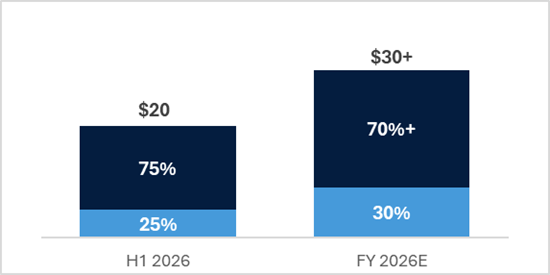
Source: Jefferies H1 2026 credit secondaries buyer survey detail and estimates.
2. Valuation Visibility Has Improved Meaningfully
Uncertainty over marks was a primary reason activity slowed. With Q1 and Q2 marks in hand and Q3 soon providing another data point, buyers can better distinguish temporary mark-to-market noise from fundamental credit deterioration. Seasoned portfolios also offer transparency that blind-pool commitments lack. Buyers can directly evaluate known borrowers, payment histories, current yields, leverage, amendment activity, portfolio construction, and the GP’s valuation discipline.
3. Smaller Transactions Are Broadening the Buyer Universe
Late 2025 and early 2026 saw several large transactions that only the deepest pools of capital could absorb. More recent opportunities have featured $250 million to $500 million of equity, a size within the target investment of newer platforms, specialist credit investors, and established secondary buyers with dedicated credit strategies. In some cases, broader participation has created increased competitive tension, improving execution confidence and pricing for high-quality portfolios managed by marquee GPs.
4. Pricing Momentum Has Returned
The bid-ask spread that widened earlier in 2026 has begun to narrow. Competition has improved pricing for seasoned, performing senior secured portfolios with strong asset quality, GP quality, and transparency. But the market remains discerning. Buyers continue to scrutinize stressed credits, uncertain valuations, limited GP access, and challenged sectors. Better pricing can become self-reinforcing, drawing out supply, attracting buyers, and increasing execution certainty.
5. Dedicated Credit Secondaries Capital Is Becoming More Institutionalized
Credit secondaries increasingly resemble private equity secondaries at an earlier stage, when dedicated capital, specialized teams, and repeat deal flow turned a niche liquidity solution into a mainstream portfolio-management tool.
Established direct lenders and private equity secondaries specialists are now evaluating or launching dedicated credit secondaries strategies, suggesting they view supply as durable. More permanent capital should deepen underwriting capacity, support more complex structures, and provide liquidity through market cycles.
6. BDC Redemption Pressure Could Create Additional Supply in 2027
Non-traded BDCs have faced elevated redemption requests, while redemption caps limit how quickly investors can exit. If the pressure persists, secondary sales could prove to be a rational liquidity-management tool, raising cash without relying solely on repayments, refinancings, or new fundraising. For buyers, BDC portfolios may offer diversified exposure to seasoned private credit assets with current income and established track records. Structures are still emerging, but the opportunity warrants close attention in 2027.
Exhibit B: Historical Public BDC Price / NAV (2)
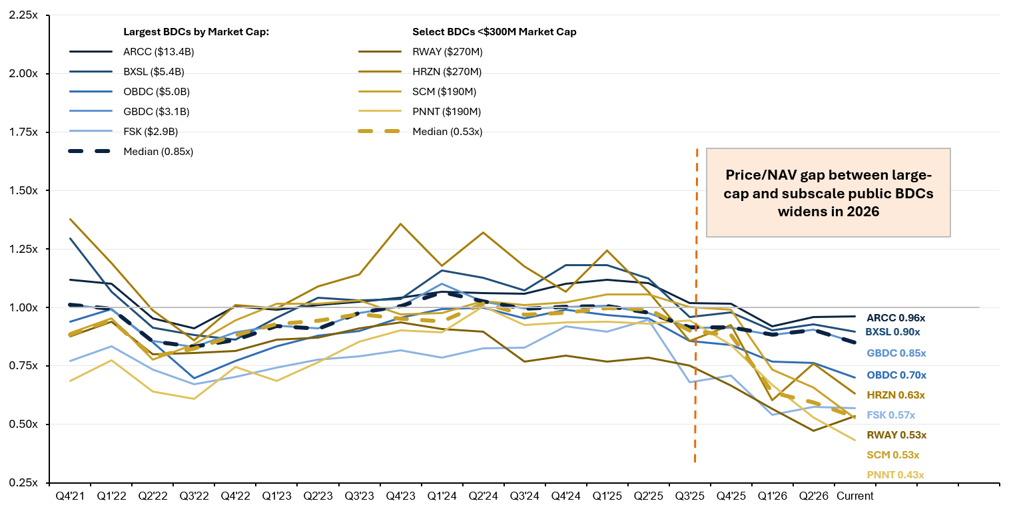
Source: Bloomberg trading data.
7. The Market Is Expanding Beyond Traditional Corporate Credit
Growth will not be limited to corporate direct lending. Buyers are expanding into:
- asset-based finance,
- infrastructure debt,
- mezzanine and special opportunities,
- fund finance, and
- other private credit exposures.
This expands both supply and the opportunities for buyers, offering a wider range of risk, duration, collateral, cash flow, and correlation profiles. As underwriting becomes more specialized, credit secondaries can evolve from a narrow market for direct lending fund interests into a broad liquidity market for private credit.
Exhibit C: H1 2026 Strategy Focus Breakdown
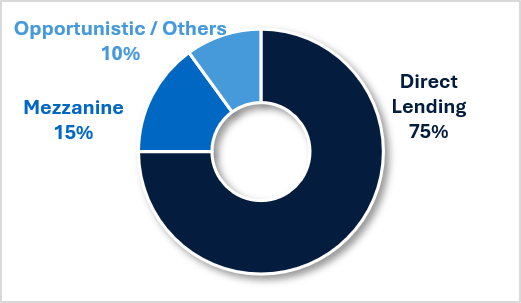
Source: Jefferies H1 2026 credit secondaries buyer survey details and estimates.
2027 and Beyond
Credit secondaries enter 2027 with renewed activity, clearer valuations, more balanced transaction sizes, broader buyer participation, and stronger pricing for high-quality portfolios. Structural supply drivers remain firmly in place. In addition, the leveraged loan maturity wall, which begins in 2028 and accelerates through 2032, is expected to create refinancing and liquidity needs, adding another catalyst for secondary activity.
The market remains selective, but Jefferies expects the segment to stay dynamic through at least 2027, supported by growing liquidity needs, a more sophisticated buyer base, and expanding opportunities. As a result, credit secondaries are transitioning from an opportunistic liquidity solution into an increasingly established component of private credit portfolio management.
Exhibit D: US Levered Loan Maturity Wall ($B)
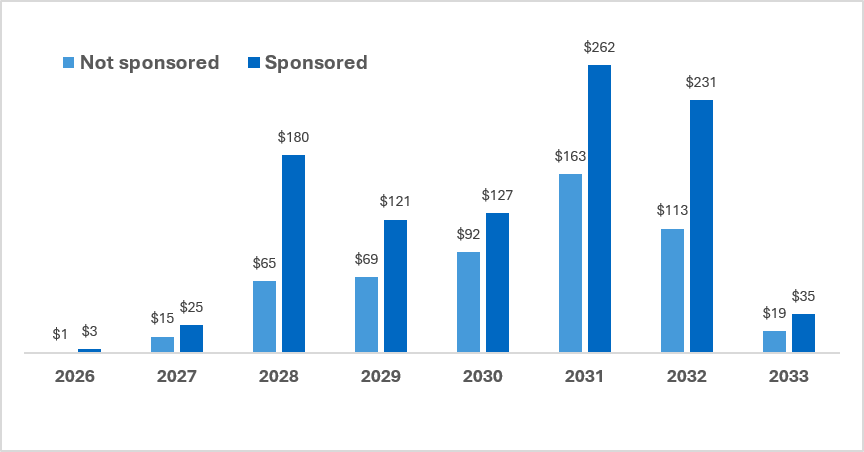
Source: PitchBook | LCD, Morningstar LSTA US Leveraged Loan Index. As of March 31, 2026.