

Team Jefferies,
Each August, our monthly letter spotlights perspectives from our global summer intern class. This tradition allows us to listen to fresh voices while also taking a moment to pause and reflect. Our interns can write about whatever they think is meaningful, whether it’s global trends, capital markets, personal growth, or their experience with Team Jefferies.
We, along with other senior leaders, reviewed every single submission, remaining blind to the authors’ identities to ensure a completely objective evaluation. This year’s letters were notably thought-provoking and insightful, and it was not easy to narrow them down. But we worked hard to identify messages we believe will spark conversation, challenge thinking, and inspire action across our global team. Please take the time to read the messages below from our three winners: Ellie Johnson, Querida Lai, Roy Vyizavyijuru. Congratulations to the three of you on a job very well done.
To all our interns, thank you for the energy and commitment you brought this summer, and for the effort you invested in these letters. Your writing is a testament to how quickly you embraced Jefferies’ values and integrated into our team and culture. Every one of you should take pride in the talent, drive, and insight you’ve demonstrated. Thank you for choosing to spend your summer with us.
To everyone across the firm, these letters should serve as a reminder of the impact you make. Thank you for the time you invested in mentoring our interns, for sharing what makes our culture distinctive, and for demonstrating the capabilities that define Jefferies. You’re helping to shape the next generation of Team Jefferies, and we are grateful.
Rich and Brian

Elizabeth (Ellie) Johnson
School: Stanford University
Division: Asset Management Summer Analyst – New York
The Best Make the Best Better
The easiest mistake to make in a high-performing environment is confusing your teammates for your rivals.
On paper, an internship can look like a competition: same start date, same deadlines, same hope of earning a return offer. Everyone wants to do well. Everyone wants to prove they belong. But after a few weeks at Jefferies, I have learned that the worst thing you can do in a competitive place is treat the people beside you like competition.
I have grown up in environments that have preached that if someone else gets noticed, you become less visible. If someone else asks the smart question, yours matters less. If someone else wins, you must have lost. This summer has taught me that the opposite is true.
As a Division I athlete, I have been working on rewriting this narrative that has been fed to so many of us for so long. Competition can be one of the most thrilling motivators, but also one of the most toxic forces. Operating in an environment where the people you work with are there to challenge you as opposed to breaking you down is extremely hard to cultivate and maintain.
Within my first 5 weeks at Jefferies this summer, I have felt the benefits of this team-first culture and seen just how much more you can learn by subscribing and committing yourself to a common mentality: the best make the best better. At Jefferies, there is absolutely no confusion between your teammates and your rivals. This allows each person to channel their energy into their work and into bettering the environment around them, as opposed to wasting it trying to bring others down in pursuit of their own success. At every turn, there has been one of my fellow interns asking if it would be helpful to have their notes to fill out my meeting summary, or an associate going to lengths to teach me the right way to do things, rather than the quick fix. It shows up when someone posts a call note detailing a finalized investment and our boss replies all: “Great team win! So proud.”
I am used to walking into a locker room every day with a John Wooden quote above the door:
“It is amazing how much can be accomplished if no one cares who gets the credit”.
I am proud to say that this sentiment has held true for each day I have been an intern over the last 5 weeks, and that I will do my best continue and spread this sentiment for every day that follows. What has impressed me most is not just how driven people are, but how willing they are to use that drive to raise the standard for everyone around them. I feel so lucky to be a part of an environment at Jefferies where I can be my most ambitious self, with the knowledge that my team is behind me rooting for me to succeed, not waiting for me to fail. In a room full of ambitious people, it is tempting to believe success is scarce. How lucky are we to be a part of a culture at Jefferies where success is derived from the process of achieving, rather than from who gets the credit.

Querida Lai
School: The University of Chicago
Division: Investment Banking Summer Analyst — New York
Nowhere to Hide
Everyone calls Jefferies flat like it’s a kindness. No egos, easy access, nobody too senior to say hello. All true. But what nobody warns you is that flat has a second meaning, and it’s the more interesting one: there’s nowhere to hide.
I understood that the first morning. I stuck my hand out and started to say “Hi, Mr. Handler!” I got two words back: “I’m Rich.” At most firms hierarchy is scaffolding. It holds you up, but it also gives you something to stand behind. Take that away and your work has to answer for itself, with nothing in front of it.
You feel that fast as an intern. Early on I spent most of a day on a single page, and I was pretty proud of it: everything aligned, the formatting clean, every box lined up. My associate looked at it for a few seconds and asked what the page was actually trying to say. I didn’t have a good answer. I’d made it look finished without making it mean anything, and that’s a hard place to hide here. Someone always ends up asking.
I thought being asked would feel worse than it did. She didn’t make a thing of it. She spent ten minutes she didn’t have walking me through how she’d tell the story — why the page existed, what the reader was supposed to walk away with. That kept happening all summer. Nobody did the work for me, but nobody let me sink either, and it took me a while to see how rare that second part is. It’s easy to be left alone when you’re exposed. At Jefferies, people step toward you instead.
I think that’s what people are really describing when they call us flat. Everyone’s fingerprints are on the work, so everyone owns it, and because they own it, they show up for it, and for each other. That isn’t softness; it’s the most demanding place I’ve worked. It’s also the warmest, and I’ve stopped believing those two things pull against each other. It’s probably why a firm that had to build its seat at the table, instead of being handed one, keeps taking deals the bigger names assumed were theirs. It’s hard to feel entitled to anything when your name is sitting on all of it.
So if I get one wish from down here, it isn’t that we stay friendly. Friendly is easy, and it’s the first thing to soften as a firm gets bigger. It’s that we keep the harder thing: the intern’s number still has to matter, the slide still has to earn its place, and someone still has to turn toward the person who’s in over their head instead of walking past.
“Nowhere to hide” only sounds like a warning. What it really means is that no one here stays hidden for long — someone always finds you, and at Jefferies they find you to help. That’s the whole thing, and I didn’t know how rare it was until I got here. Ask me in ten years. I hope I am the person who finds the overwhelmed kid on their first morning, the way people kept finding me this summer.
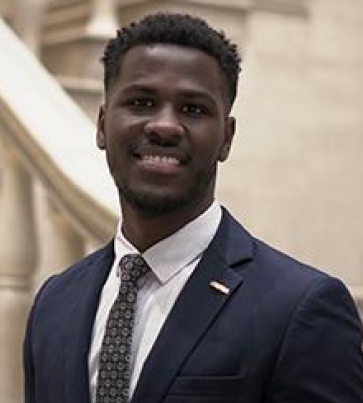
Roy Vyizavyijuru
School: Vanderbilt University
Division: Investment Banking Summer Analyst – New York
Show Up and Go for It
Growing up in Burundi, a small, landlocked country in East Africa, my dreams were never supposed to break the mold. At 11 years old, a civil war forced me to leave home and pursue an education in another country alone. New culture, new language, new environment: it felt like my life had restarted from zero. But instead of seeing it as the end of something, I chose to see it as the beginning of something bigger. That experience pushed me beyond the limits I once imagined for myself. I learned English, my fourth language, and suddenly my dreams soared again. If I could do that, why not apply to colleges in America? Once again, I showed up and went for it.
When I arrived in the United States, I found myself alone again: new country, new people, new expectations. I had no understanding of the finance industry and often woke up questioning whether I truly belonged in those spaces. But over time, I learned that growth comes from humility: putting your head down, asking questions, seeking guidance, and learning from people around you.
This summer in New York felt familiar but in a different way. Another new city. Another unfamiliar environment. Everything moved fast. But when I walked into Jefferies, for the first time in a long time, I did not feel alone. The pressure to perform was higher than ever. Ironically, unlike geography, the higher I climbed, the greater the pressure became. But at Jefferies, alongside that pressure came people who were willing to help carry it with you. From the very first day, Rich Handler said “No one in this room is your competitor. Work collaboratively, support each other and succeed as a team” and I truly began to understand those words once I hit the desk.
At Jefferies, every analyst, associate, vice president, and managing director works together to perfect the craft. That teamwork is what refines the substance people eventually see from the outside. When people hear the name Jefferies, it is easy to focus only on the reputation. But once you are inside, it feels more like a team inside a locker room, where everyone has a role to play in the success of the group. You see senior bankers mentoring juniors, analysts passing down advice and work ethic to interns, and people constantly investing in one another’s growth.
At first, I felt like a baby being carried through the process. I received tasks I did not fully understand, but I kept my head down, asked questions, attempted the work, and improved through feedback. Then, within a few weeks, I began taking my own steps. I became involved in conversations, meetings, trainings, and discussions where my opinions mattered. I learned how to think critically about solving problems and how much attention goes into producing the best possible work. Every experience raised my sights even higher.
More importantly, I always felt like part of something bigger than myself. Whether I had a good day or a difficult one, I still felt supported. That environment made me wake up every morning with gratitude, confidence, and a positive attitude toward the work.
One of the biggest lessons I take away from this experience is simple: always show up and go for it. I was once a refugee who believed he could touch the skies, and step by step, I am getting there. Why? Because I kept showing up and going for it, even when the odds seemed against me. In finance, we deal with uncertainty every day. Markets move unpredictably overnight, yet we still wake up and attempt to understand them. We value companies and project their futures without knowing exactly what will happen tomorrow, yet we trust the process enough to try.
So, what is stopping you from projecting your own dreams? I came to Jefferies with an equity value close to zero, but people invested in me, gave me leverage, and helped increase my enterprise value beyond what I thought was possible. I learned that the legacy of an institution is built through its people and their commitment to perfecting the craft every single day. We all contribute to that process in our own way. You never truly know how much you can achieve until you give yourself the chance to try.
So, Show Up and Go for It. I did, and I never regretted it.